The disclosure first, because it shapes everything after it: we make an AI receptionist, and it is one of the six options in the table below. Read this the way you would read a Moneypenny page about answering services, then go and check the half that matters. Every price here comes from the provider's own published UK pages, fetched on 8 September 2026, and where a provider publishes no price we say so rather than guess.
The short answer: a dental answering service is a human team that takes your practice's overflow and out-of-hours calls. Human services run from about £49 a month for message taking to around £200 for a full dental package, and three of the five providers we checked publish no price. An AI receptionist does the routine booking work from £49 a month on the founding rate, if your diary lives in Google Calendar or Outlook.
What does a dental answering service actually do with the call?
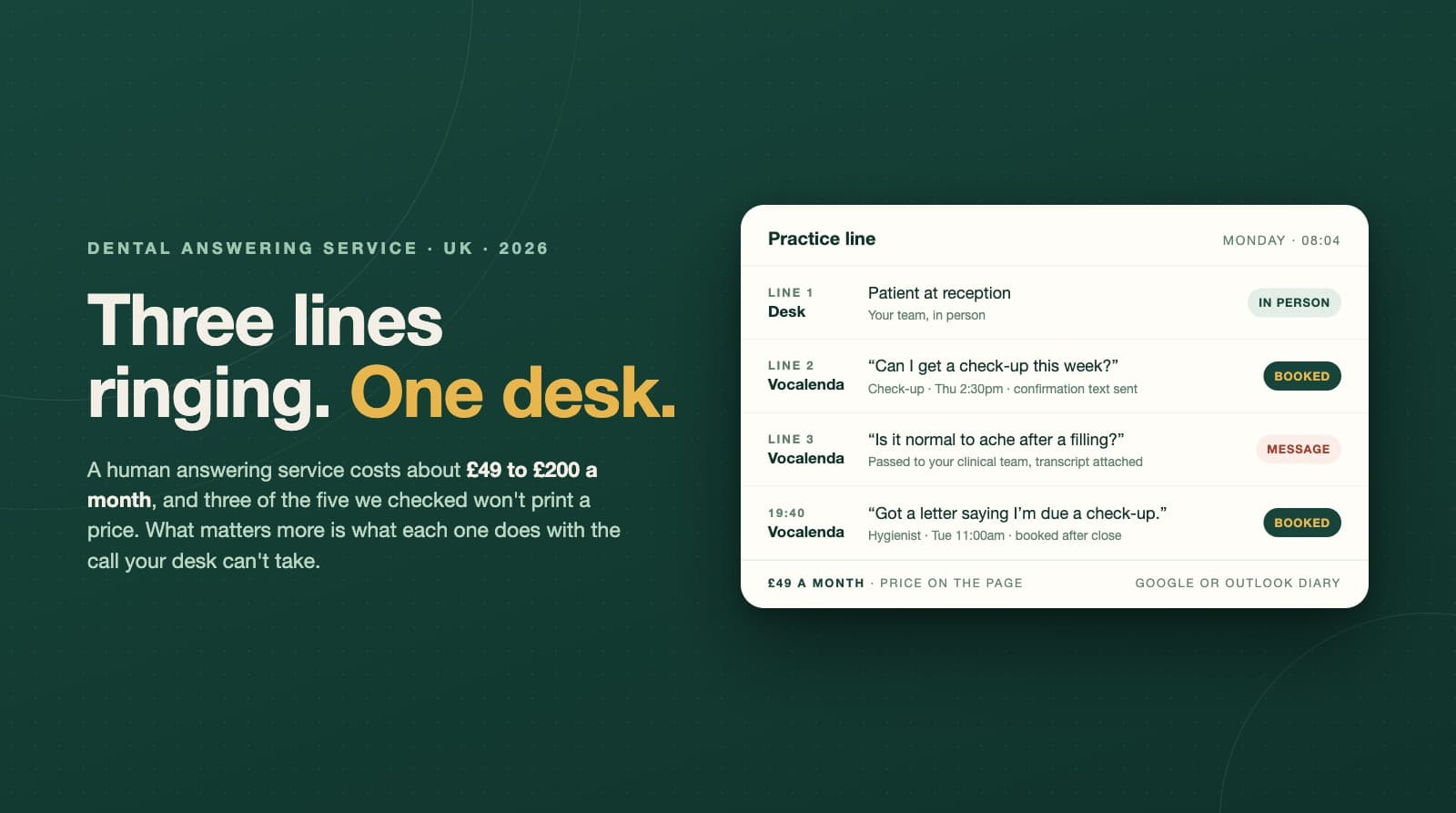
Monday, 8am. A patient at the desk, a recall letter that landed on Saturday, and every line ringing. Your reception team can only be in one conversation at a time, and the calls they cannot take go to voicemail, which for a new patient is the same as going to the practice down the road.
A dental answering service exists for those calls. In the traditional version, a team of receptionists at another company answers in your practice's name, takes the patient's details and reason for calling, and either passes the call through, sends you a message, or, on the better packages, books the appointment into your diary. The service covers the calls your desk cannot reach: overflow at peak times, lunchtimes, evenings and weekends.
Now the same job has a second answer. An AI receptionist answers the practice line itself, checks the diary, books the check-up while the patient is still on the phone, and texts a confirmation. It is cheaper, it takes up to three calls at once with nobody on hold, and it has limits that this post states as plainly as the prices. Whichever you pick, the question to hold onto is the same one throughout: what happens to the call your desk cannot take? Voicemail, a message, or a booking are three very different answers, and the price on its own does not tell you which one you are buying.
How much does a dental answering service cost in the UK?
On the providers' own pages, checked 8 September 2026, the answer is from about £49 to around £200 a month for a human service, and from £49 a month on the founding rate for an AI one, with the important detail that three of the five other providers below do not publish a price at all.
| Provider | Human or AI | Published price, 8 September 2026 | Books into your diary? | Cover | Trial |
|---|---|---|---|---|---|
| Face for Business | Human | "Around £200 a month" for its most popular dental package; plans from £49 (business hours, messages) and from £115 (evenings and weekends, appointment booking) | Yes, on the Inclusive Minutes plan | Mon to Fri 8am to 8pm, Sat 9am to 5:30pm, Sun 10am to 4pm | 7 days |
| Moneypenny | Human, with an AI option for routine calls | Not published: "based on usage", quote per practice | Yes, "with your calendar to hand" | Around the clock | Free trial, length not stated |
| Best Reception | Human | Not published: quote by phone or email | Yes, on its Virtual Receptionist and Appointment Booking package | Not stated on the dental page | 14 days |
| Answer4u | Human, with an AI receptionist option | Not published: contact form | Not stated on the dental page | 24/7 | Free trial offered on its homepage, length not stated |
| Voco | AI | £49 a month for 75 calls, then 75p a call up to a £20 cap; £149 for 250 calls; £249 for 500 calls; or pay as you go at 29p a minute ex VAT | Yes, where calendar integration is enabled | 24/7 | 30-day money-back guarantee |
| Vocalenda | AI | £49 a month flat on the founding rate (standard £69), 500 call minutes included | Yes, live Google Calendar or Outlook, per practitioner | 24/7 | 30 days |
A fair warning before you subtract one row from another: this is not like for like. A human service is billed on usage, by the second on Face for Business's inclusive-minutes package, so "around £200" is a typical month for a practice, not a ceiling. The flat AI prices buy an allowance: 75 calls at Voco's entry plan with a cap that stops the bill at £69, and 500 minutes at Vocalenda, which is around 250 bookings at a typical two-minute call. What happens at the limit runs the other way, and it belongs here rather than in a footnote: Voco's pricing page says calls are never cut off once its cap is reached, whereas a Vocalenda line that uses all 500 minutes pauses until the month resets or a £59 top-up is bought. VAT is one more axis the pages do not all state: only Voco's pay-as-you-go rate is marked as excluding VAT, so ask every provider, us included, whether the figure you are quoted includes it. Hours of cover differ too. Face for Business's out-of-hours desk closes at 8pm on weekdays and 4pm on a Sunday; Moneypenny, Answer4u and the two AI options answer around the clock.
The row to read twice is the one that says where the booking goes. A service that captures the call as a message still leaves your team ringing the patient back the next morning, and on a recall call that is the moment the patient has already booked elsewhere. Every price in the table should be read next to that column.
Why three of the five don't publish a price
Because they price on usage, and they say so. Moneypenny's healthcare page describes its services as "based on usage - so you're always in control", and its own guide to answering service costs puts the UK market at "around £25 to £500 or more per month, depending on call volume, hours of cover, and features such as appointment booking or CRM integration", which is an honest range and also a wide one. Best Reception and Answer4u take the same approach: a free trial, then a quote.
There is nothing wrong with that model. A large practice with four lines and an NHS contract genuinely has a different call pattern from a two-surgery private practice, and a tailored quote can reflect it. But it means the comparison work lands on you. Before the trial, ask each provider for three numbers in writing: the monthly total at your real call volume, the per-minute or per-call rate once you exceed it, and whether appointment booking is in that price or a package above it.
The two AI providers and Face for Business publish their prices on a page, and we think a small practice is entitled to that. Ours is here: £49 a month on the founding rate for the first ten businesses, £69 after that, one plan, everything included, with the one limit stated on the same page. If a practice uses all 500 minutes in a month the line pauses until the month resets, with a warning on your dashboard well before, and a one-off top-up of 500 minutes costs £59. There is no surprise bill because there is no meter.
Human or AI: which should answer a dental practice's phone?
Here is the concession, and it is a real one. A human receptionist brings judgement to a call, and some dental calls need it.
Choose a human service when the call itself needs a decision: an NHS practice triaging urgent patients against limited slots, a practice whose appointment book lives entirely inside practice-management software that nothing else can read, or a front desk where the receptionist is expected to weigh a patient's description and decide what kind of appointment they need. An AI receptionist is built not to make clinical decisions, and for those practices that is a limitation, not a feature. Moneypenny itself draws the same line on its healthcare page: its AI agent is "the ideal solution for more routine calls that don't always require the human touch", with escalation to its people.
Choose an AI receptionist when most of your unanswered calls are routine and the cost of missing them is a lost patient rather than a clinical risk. That is the Monday queue, the lunchtime overflow, the recall letter that gets read at 7:40pm, and the new patient ringing three practices to see who picks up. On those calls an AI answers immediately, in parallel, at 3am or 8am, checks live availability and finishes the booking, then sends the confirmation text that cuts did-not-attends. At the £49 founding rate it costs a quarter of Face for Business's most popular dental package, about a third at the standard £69, because it does a narrower job, and you should only buy it if the narrower job is the one you need done. Our virtual receptionist vs AI receptionist guide walks through the same fork for other kinds of business.
What the AI must never do is play dentist. Vocalenda's receptionist never diagnoses, never says whether a treatment is safe or suitable, and never picks a treatment for a caller. "Is it normal to ache after a filling?" becomes a message for your clinical team, on your dashboard with the full transcript before the patient has hung up, or a transfer to the desk if you prefer. A patient mentioning a condition never stops their booking. You can hear the rule hold on the demo line: ask it whether a treatment is safe for a condition and listen to it pass the question on instead of answering.
Here is the other side of that rule: a new patient mentions an aching tooth, gets no advice about it, and is booked in for a check-up that afternoon:
Sample call

A new patient check-up at a dental practice
Thalia · Mellorby Dental Practice
0:58
A sample call with a made-up business. The receptionist's voice is the one real callers hear.
Read the transcript
- Receptionist: Just so you know, you're speaking with an AI assistant, and this call is transcribed. Thank you for calling Mellorby Dental Practice, how can I help you today?
- Caller: Hi, I'm new to the area and I'd like to book in as a new patient. One of my back teeth has been aching, so the sooner the better, really.
- Receptionist: Sorry to hear that. Let me see what we've got today.
- Receptionist: Dr Patel can see you today at two thirty PM.
- Caller: Oh, that's brilliant. I'll take it.
- Receptionist: And what name shall I put it under?
- Caller: Sophie Grant.
- Receptionist: So that's a new patient check-up for Sophie Grant with Dr Patel today, Thursday the 15th, at two thirty PM. Shall I book it?
- Caller: Yes, please.
- Receptionist: Okay, booking that now.
- Receptionist: You're booked in, and a confirmation text is on its way. Anything else I can help with?
- Caller: No, that's all. Thanks so much.
- Receptionist: Thanks for calling Mellorby Dental Practice, have a great day!
What happens with a dental emergency call?
Nobody should learn their answering service's emergency behaviour from a patient. The NHS's own guidance, on its page about accessing a dentist in an emergency or out of hours, says: "If you need emergency or urgent dental care you can get advice from NHS 111 or contact a dentist and ask for an appointment." The same page lists the situations that mean "Go to A&E or call 999", including serious facial injuries, uncontrolled bleeding and swelling that affects breathing.
A human service will follow whatever protocol you agree with it. An AI receptionist should do exactly the same and nothing more. On Vocalenda you write your emergency arrangements and it passes them on when asked, whether that is your out-of-hours number, the NHS 111 line, or "come straight in and we will fit you in", and it can transfer urgent callers directly to the desk or to an emergency line. If a caller describes immediate danger, it tells them to hang up and call 999. What it does not do is decide for itself how urgent a toothache is, because that is a clinical judgement and it is yours.
The one question that decides it: where does your appointment book live?
Strip away the price table and the choice comes down to a single question, the same one that decides every comparison on this blog: where does your diary live?
If your practice runs on a practice-management system and the appointment book lives only there, a human answering service that logs into your system, or an AI product that integrates with it, is the honest choice. Vocalenda does not book into practice-management software today. It books into Google Calendar and Outlook or Microsoft 365, each practitioner with their own calendar, up to five included, and it reads their real availability while the patient is on the line. If your book already lives there, or mirrors there, you get the whole thing: the hygienist's own column, the check-up written in on Thursday at 2:30, the confirmation text, the reminder the day before, and the reschedule when the patient rings back. If it cannot mirror there, we are not the right fit yet, and we would rather say so on this page than on a support ticket.
That is the boundary for our product. For the human services the question runs the other way: ask whether their receptionists work inside your practice-management system, because what you are paying for is a person's time, billed on usage, to the second on Face for Business's inclusive-minutes package.
What the law asks of whoever answers
We are not solicitors and this is not legal advice for your practice; the ICO's pages, linked from the post below, are the authority. Whoever takes the call, human or AI, is handling patient data on your behalf, and the rules are the same for both. Your practice is the data controller; the answering service is your processor; the UK GDPR requires a written contract between you with specific terms, a documented lawful basis, and callers told at the point their details are collected. Anything a patient says about why they are booking may be health information, which is special category data, and the condition for handling it, usually provision of health care under Article 9(2)(h), is the practice's to establish.
We wrote the long version in Is an AI receptionist UK GDPR compliant?, with the ICO's own pages linked on every claim and seven questions to put to any provider. The short version for a dental practice: ask for the Article 28 agreement in writing, ask what the caller hears at the start of the call, and ask what is kept and for how long. Vocalenda's answers are one sentence spoken before your greeting on every call that the caller is speaking with an AI and the call is transcribed, no audio recording kept, with one disclosed trade-off: our speech provider uses call audio to improve its models unless the caller objects, and the GDPR post explains the objection route. Transcripts are deleted after 24 months, and the data processing agreement is published rather than negotiated.
Choose a human dental answering service if...
- Calls need judgement on the line. Urgent NHS triage, deciding appointment types from a patient's description, anything where a receptionist's discretion is part of the job.
- Your appointment book lives only in practice-management software and nothing else can read it. Ask the human service to confirm its receptionists work inside your system, and that the package you are quoted includes booking, not just messages.
- You want a person's voice for every call, whatever it costs. Face for Business publishes around £200 a month for its most popular dental package; the others will quote you.
Choose an AI receptionist like Vocalenda if...
- Your missed calls are routine and expensive. Overflow, lunchtimes, evenings, recall calls after work: bookings, reschedules and price questions that an AI can finish in the call, with a confirmation text on the way before the patient has put the phone down.
- Your diary is Google Calendar or Outlook, or can mirror there, for each of up to five practitioners.
- You want the price on a page. £49 a month flat on the founding rate, 500 minutes, texts and reminders included, a 30-day free trial, no contract, and the one limit stated next to the price. See the dental page for what it handles, or compare it against seven UK AI receptionists and six Moneypenny alternatives in our wider guides.
The short version
A dental answering service costs from about £49 to around £200 a month on the pages that publish a price, and a quote everywhere else. The price matters less than two columns in the table above: whether the call ends with a booking or a message, and where that booking lands. If your calls need a person's judgement or your book is locked inside practice-management software, pay for the human service and insist on appointment booking in the package. If your calls are routine, your diary is Google Calendar or Outlook, and the cost of a missed call is the patient who books elsewhere, an AI receptionist does the job from £49 a month on the founding rate. Do not take our word for how it sounds: the demo line is our own test barbershop's number, and the manner, the booking flow and the confirmation text are exactly what a patient would get. Call +44 7888 866273, try to book something, then ask it a clinical question and listen to what it does. Then start the 30-day free trial if it earned it.
Common questions
How much does a dental answering service cost in the UK?
On the providers' own pages, checked 8 September 2026, a human dental answering service runs from about £49 a month for business-hours message taking to around £200 a month for the most popular dental package at Face for Business, with evening and weekend cover and appointment booking from £115 a month there. Moneypenny and Best Reception publish no price and quote per practice, and Answer4u's dental page gives none, though its virtual receptionist page lists £19.99 a month plus from £1.75 a call (checked 24 September 2026); Moneypenny's own guide puts UK answering services at roughly £25 to £500 or more a month depending on volume, hours and features. AI receptionists sit at the bottom of that range: Voco from £49 a month for 75 calls, and Vocalenda at £49 a month flat on the founding rate with 500 call minutes included.
Do dental answering services book appointments into my diary?
The better ones do, but check which package. Face for Business lists appointment booking on its Inclusive Minutes plan from £115 a month, not on its Taster plan from £49, which captures calls as messages. Moneypenny says that with your calendar to hand its receptionists schedule appointments directly into your diary. An AI receptionist books during the call by reading your live calendar: Vocalenda checks each practitioner's real availability in Google Calendar or Outlook, writes the appointment in while the patient is still on the line, and texts them a confirmation.
Can an AI receptionist handle a dental practice's phone?
For the routine calls, yes: new-patient enquiries, check-up and hygiene bookings, reschedules, cancellations, prices, opening hours and recall calls that land after 5pm. It answers up to three calls at once with nobody on hold; a fourth caller at that moment hears that all lines are busy and is asked to call back in a few minutes. What it must not do is give clinical advice, and a properly built one is designed not to. Vocalenda passes any clinical question to your team as a message or a transfer, tells anyone in immediate danger to call 999, and passes on your own emergency arrangements when a caller asks. Practices that need human judgement on every call, or whose diary lives only inside practice-management software, are still better served by a human service.
What does an AI receptionist do with a dental emergency call?
It follows the script you give it and never decides for itself how urgent a symptom is. You write the emergency arrangements, for example your out-of-hours number, the NHS 111 line or an instruction to come straight in, and Vocalenda passes them on when a caller asks, or transfers the caller straight to the desk or an emergency line. A caller describing immediate danger is told to hang up and call 999. The NHS's own guidance on emergency dental care is linked in the post so you can build your script from it.
Does Vocalenda work with Dentally, SOE Exact or other practice-management software?
Not directly, and it is better to know that now. Vocalenda books into Google Calendar and Outlook or Microsoft 365, one calendar per practitioner, up to five included. If your appointment book lives only inside a practice-management system and cannot be mirrored to Google Calendar or Outlook, it is not the right fit yet; ask a human answering service whether its receptionists can work inside your system instead. If the book is on Google or Outlook, or mirrors there, everything works: live availability, the booking written in during the call, confirmation texts and reminders.
Is it safe for an AI to take patient details under UK GDPR?
It can be, on the same terms that apply to a human answering service. The practice is the data controller and whoever answers the phone is its processor, so the law needs a written Article 28 contract between you, a documented lawful basis, and callers told at the start of the call what is happening. Anything a patient says about why they are booking may be health data, which is special category data, and the condition for handling it is the practice's to establish, usually provision of health care. Vocalenda states one sentence before your greeting that the caller is speaking with an AI and the call is transcribed, keeps no audio recording, though its speech provider uses call audio to improve its speech models unless the caller objects, which is honoured from their next call, deletes transcripts after 24 months, and publishes its data processing agreement at vocalenda.com/dpa.
Want more guides like this in your Google results? Add Vocalenda as a preferred source.
Add Vocalenda on Google